
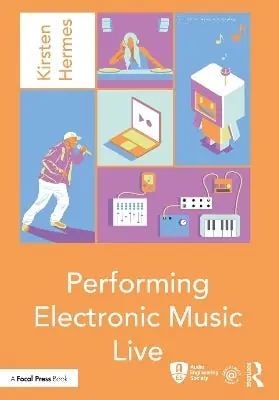
Description
By (author) Hermes Kirsten Short description/annotation:
This comprehensive book lays out the conceptual approaches, tools and techniques for performing electronic music, from DJing, DAWs, MIDI controllers, traditional instruments, live sound design, hardware setups, custom software and hardware to live visuals, venue acoustics and live show promotion.
Description:
Performing Electronic Music Live lays out conceptual approaches, tools, and techniques for electronic music performance, from DJing, DAWs, MIDI controllers, traditional instruments, live sound design, hardware setups, custom software and hardware, to live visuals, venue acoustics, and live show promotion. Through case studies and contrasting tutorials by successful artists, Kirsten Hermes explores the many different ways in which you can create memorable experiences on stage. Featuring interviews with highly accomplished musicians and practitioners, readers can also expand on their knowledge with hands-on video tutorials for each chapter via the companion website, performingelectronicmusic.live.
Performing Electronic Music Live is an essential, all-encompassing resource for professionals, students of music production courses, and researchers in the field of creative-focused performance technology.
Table of contents:
Chapter 1 – General Advice
1. The concept
2. Confidence and preparation
2.1 Effective rehearsal
2.2 Dealing with stage fright
2.3 Stepping into the performance persona
2.4 Using feedback and being prepared for rejection
3. Quality of the production
4. Factors that determine the setup choice
4.1 The music – genre and composition
4.2 The act – personality, motivation and skills
4.3 Band members and skills
4.4 The performance situation
4.4.1 The audience
4.4.2 The venue and playback system
4.4.3 Risk
4.4.4 Budget
4.4.5 Need for portability
Tutorial and takeaway points
5. References
Chapter 2 – DAWs and Controllers
1. Non-linearity of time
2. Overview of performance DAWs
2.1 Ableton Live
2.2 Bitwig
2.3 Maschine
2.4 Logic Pro X
2.5 Motu Digital Performer
2.6 FL studio
2.7 Standalone hardware DAW equivalents
3. Plugging in hardware
3.1 Live arrangement
3.2 One-shots and finger drumming
3.3 Performing on software instruments
3.4 Controlling audio effects
3.5 Other external hardware
4. Prepared musical material and live recording
5. Collaboration
6. Randomness and generative approaches
7. Customising the performance interface
8. Performing live in more studio-oriented DAWs
9. Working with visuals
10. Recording the show
Tutorial
From a complex studio production to an intuitive live set
Looping clips
One-shots
Follow actions
Live effects
Live keys and vocals
Visuals
11. Takeaway points
References
Interview with Robert Henke
Chapter 3 – MIDI and CV Performance Controllers
1. CV/GATE
2. The MIDI protocol
2.1 MIDI messages in the MIDI 1 protocol
2.2 MIDI 2.0
3. Types of performance controllers
3.1 Buttons
3.2 Continuous signals: knobs, faders, sliders
3.3 Controllers that resemble traditional musical instruments.
3.4 Modular controllers
3.5 Motion-controlled performance hardware
3.6 Turning non-musical hardware into MIDI controllers
3.7 MIDI Polyphonic Expression
3.8 Sequencers
3.9 Clock signals and MIDI routing
Tutorial
4. Takeaway points
References
Chapter 4 – DJing and Turntablism
1. A short history of DJing
2. Types of DJ in the present day
2.1 Touring artist-DJs
2.2 Resident DJs
2.3 Mobile event DJs